If you ask ten dispatchers what the hardest part of their job is, you’ll probably get ten different answers.
Some will say finding quality loads.
Others will mention dealing with brokers, managing drivers, or keeping up with paperwork.
After spending years in the trucking and logistics industry, I’ve realized something different.
The biggest problem isn’t any one task. It’s the number of disconnected tasks dispatchers have to manage every single day.
A dispatcher isn’t just assigning loads. They’re talking to brokers, checking truck availability, tracking drivers, updating customers, reviewing documents, monitoring compliance, negotiating rates, and solving problems that no software can predict.
I’ve seen dispatchers spend more time switching between applications than actually dispatching freight.
That isn’t a people problem. It’s a workflow problem.
This is exactly why I believe AI dispatch software is becoming one of the most important technologies in modern logistics.
Artificial intelligence isn’t here to replace dispatchers. It’s here to remove the repetitive work that prevents great dispatchers from doing what they do best, building relationships, making better decisions, and keeping trucks moving.
In this guide, I’ll explain what AI dispatch software really is, how it works, what problems it solves, and how I believe businesses should evaluate these platforms before investing.
What is AI dispatch software?
At its core, AI dispatch software is a platform that helps dispatchers make better decisions by combining automation, data analysis, and artificial intelligence into a single workflow.
Traditional dispatch software acts like a digital filing cabinet. It stores information, but it still expects dispatchers to do most of the thinking.
AI works differently.
Instead of simply displaying information, it continuously analyzes what’s happening across your operation.
It can understand where your trucks are located, which drivers are available, how much driving time they have remaining, which loads generate the highest revenue, and which routes make the most operational sense.
Rather than manually comparing dozens of variables, AI presents recommendations that help dispatchers make faster and more informed decisions.
I like to describe AI dispatch software as a second dispatcher that never gets tired.
It doesn’t replace experience.
It enhances it.
The AI dispatch intelligence framework
I like to think about AI dispatch software as a continuous decision-making system rather than just another dispatch platform. Every successful AI dispatch workflow follows the same five stages.
AI DISPATCH INTELLIGENCE FRAMEWORK
Customer Load Request
│
▼
Collect Operational Data
GPS • ELD • Drivers • Trucks • Customers • Documents
│
▼
Analyze Thousands of Variables
Routes • HOS • Equipment • Traffic • Weather • Rates
│
▼
Recommend the Best Operational Decision
Best Driver • Best Truck • Best Route • Best Timing
│
▼
Automate the Remaining Workflow
Dispatch → Driver → Customer → Tracking → Documents → Reports
Why is traditional dispatching becoming harder?
Dispatching has never been simple.
What has changed is the complexity of modern freight operations.
Customers expect real-time visibility.
Drivers expect faster communication.
Fuel costs continue to fluctuate.
Compliance requirements become stricter every year.
At the same time, fleets are expected to move more freight with fewer resources.
Unfortunately, many dispatch teams still operate using workflows that haven’t changed in years.
A typical day often looks something like this:
- Search multiple load boards
- Call several brokers
- Check driver availability
- Compare rates
- Update spreadsheets
- Send paperwork
- Respond to customer emails
- Track deliveries
- Follow up with drivers
- Organize documents
None of these tasks are particularly difficult on their own.
The challenge is doing all of them simultaneously while making hundreds of decisions throughout the day.
Every interruption increases the likelihood of mistakes.
Each manual process slows the business down.
Each unnecessary phone call consumes valuable time.
Eventually, growth becomes difficult because adding more trucks also means adding more administrative work.
That’s usually the point where companies begin looking for automation.
What are the biggest misconceptions about AI dispatch software?
One misconception I hear regularly is that AI will replace dispatchers.
I don’t believe that’s true.
Dispatching is still a people business.
Relationships matter.
Negotiations matter.
Customer service matters.
Those skills can’t be replaced by software.
What AI does exceptionally well is handling repetitive operational work.
Instead of manually entering information into multiple systems, AI can automatically process documents.
Rather than checking whether a driver has available hours, AI can identify qualified drivers in seconds.
Instead of spending time updating customers, automated workflows can keep everyone informed without additional effort.
The dispatcher still makes the final decision.
AI simply provides better information, faster.
How I think about AI dispatch software?
Over time, I’ve started looking at AI dispatch software through three connected layers.
Understanding these layers makes it much easier to evaluate different platforms.
Layer one: operational intelligence
Everything begins with data.
A modern dispatch platform collects information from multiple sources, including:
- GPS tracking
- Electronic Logging Devices (ELDs)
- Driver schedules
- Customer orders
- Equipment availability
- Dispatch history
- Route information
- Shipment updates
Without reliable operational data, artificial intelligence cannot make reliable recommendations.
This is why integrations matter just as much as AI itself.
Layer two: decision intelligence
This is where AI begins creating measurable value.
Instead of asking,
“Which truck should I dispatch?”
the software already understands several important factors.
It knows:
- Which drivers are available
- Which truck is closest
- Which route minimizes empty miles
- Which delivery has the highest priority
- Which assignment creates the best operational outcome
Instead of forcing dispatchers to search through dozens of screens, AI brings the answer directly to them.
The final decision always belongs to the dispatcher.
The research simply happens much faster.
Layer three: workflow automation
After the dispatcher approves the assignment, AI continues working behind the scenes.
This includes tasks such as:
- Sending dispatch instructions
- Updating customers
- Generating documents
- Tracking shipment progress
- Monitoring delays
- Organizing paperwork
- Creating operational reports
This is where businesses usually notice the biggest productivity improvements.
The dispatcher spends less time on administration and more time managing freight.
What are the top features that actually matter in AI dispatch software?
One mistake I see businesses make is comparing software based on the number of features.
More features don’t automatically create a better dispatch platform.
What matters is whether those features solve real operational problems.
If I were evaluating AI dispatch software today, these are the capabilities I would prioritize.
Intelligent load matching
Every dispatcher has experienced the pressure of finding the right truck quickly.
Traditionally, this means checking driver availability, equipment type, current location, customer requirements, and delivery schedules before making several phone calls.
AI can analyze these variables in seconds.
Instead of manually searching for the best option, the platform recommends the most suitable truck based on operational data.
That doesn’t eliminate the dispatcher’s role. It simply removes the repetitive research that slows the process down.
Route optimization
Route planning is about much more than choosing the shortest distance.
A good AI dispatch platform considers:
- Traffic conditions
- Weather
- Delivery appointments
- Fuel efficiency
- Toll costs
- Driver Hours of Service
- Historical route performance
When these factors are evaluated together, dispatchers can reduce unnecessary mileage while improving delivery reliability.
Real-time fleet visibility
You can’t manage what you can’t see.
One of the biggest improvements AI brings is complete operational visibility.
Instead of wondering where a truck is, dispatchers can view real-time updates from a single dashboard.
This creates better communication with customers while allowing dispatch teams to respond quickly when unexpected delays occur.
Automated document processing
Paperwork remains one of the biggest productivity killers in trucking.
Bills of Lading.
Rate Confirmations.
Proof of Delivery.
Invoices.
Carrier packets.
These documents are essential, but manually processing them consumes hours every week.
Modern AI platforms use Optical Character Recognition, commonly known as OCR, to extract information automatically.
Instead of entering shipment details manually, the software reads the document and organizes the information for you.
Besides saving time, this also reduces human error.
AI-powered communication
Communication often becomes a full-time job for dispatchers.
Drivers need updates.
Customers request shipment status.
Brokers ask for ETAs.
Internal teams need information.
Instead of manually writing the same messages throughout the day, AI can automate routine communication while keeping dispatchers informed about exceptions that actually require human attention.
Performance analytics
Good dispatchers rely on experience.
Great dispatchers combine experience with data.
AI software can identify patterns that are difficult to recognize manually.
For example:
- Which lanes generate the highest profit?
- Which trucks spend the most time idle?
- Which customers consistently create delays?
- Which drivers achieve the best fuel efficiency?
- Which routes produce the strongest margins?
These insights help businesses improve over time instead of making decisions based solely on instinct.
The real benefits of AI dispatch software
Whenever someone asks me about AI, they usually expect me to talk about technology.
I usually talk about people instead.
Technology only matters if it improves the way people work.
Here are the biggest improvements I’ve seen businesses achieve after adopting AI-powered dispatching.
Dispatchers spend more time dispatching
This sounds obvious, but it’s surprisingly rare.
Many dispatchers spend a large portion of their day doing administrative work instead of managing freight.
Automation changes that balance.
Instead of entering data into multiple systems, dispatchers can focus on customer relationships, problem solving, and finding better freight opportunities.
That’s where they create the most value.
Better fleet utilization
Idle trucks don’t generate revenue.
Neither do unnecessary empty miles.
AI continuously looks for opportunities to improve equipment utilization.
Sometimes that means assigning a different truck.
Sometimes it means recommending a different route.
From time to time it identifies a backhaul opportunity that might otherwise be missed.
Small operational improvements quickly add up across an entire fleet.
Faster decisions
One thing I’ve learned is that dispatching rewards speed.
The first carrier to respond often wins the load.
The first dispatcher to identify a problem usually prevents a service failure.
Artificial Intelligence reduces the amount of time required to gather information.
Instead of spending several minutes researching every decision, dispatchers receive recommendations almost immediately.
That speed creates a competitive advantage.
Better customer experience
Customers don’t judge logistics companies by how advanced their software is.
They judge them by communication.
Did the shipment arrive on time?
Were updates provided quickly?
Did someone answer when there was a problem?
AI helps businesses provide consistent communication without increasing administrative workload.
That consistency builds trust.
Improved scalability
Eventually, every growing business reaches the same challenge.
More trucks require more dispatchers.</p>
Further, dispatchers require more administrative support.</p>
More administration increases operating costs.</p>
AI changes this equation.
By automating repetitive work, dispatch teams can often manage additional freight without increasing headcount at the same pace.
That doesn’t eliminate hiring.
It simply allows growth to happen more efficiently.
Key takeaways
- Better truck utilization
- Fewer empty miles
- Faster load assignments
- Lower administrative workload
- Improved customer communication
- Better operational visibility
AI doesn’t create value because it’s intelligent.
It creates value because it helps dispatchers make hundreds of small operational decisions faster and with greater consistency.
Over the course of a month, those small improvements often lead to:
When does AI dispatch software deliver the most value?
Throughout this guide, I’ve talked about how AI supports dispatchers rather than replacing them. One question I hear often is, “When does AI actually make the biggest difference?”
In my experience, AI creates the most value as operations become more complex. If you’re managing one truck and one load, manual dispatching is usually manageable. But as your fleet, customers, and daily shipments grow, every additional decision adds complexity.
That’s where AI begins to stand out.
| Situation | Manual Dispatch | AI Dispatch |
|---|---|---|
| One truck available | Easy | Easy |
| Ten available trucks | Moderate | Excellent |
| Fifty active loads | Time consuming | Optimized |
| Route disruptions | Reactive | Predictive |
| Driver availability | Manual verification | Automatic |
| Customer updates | Individual calls | Automated |
| Document processing | Manual | OCR automation |
What are the differences between AI dispatch software vs traditional dispatch software?
Whenever I speak with fleet owners, one question comes up repeatedly.
“Is AI really that different from the dispatch software we’re already using?”
In many cases, the answer is yes.
Traditional dispatch software is excellent at recording information.
AI dispatch software is designed to help you act on that information.
| Traditional Dispatch Software | AI Dispatch Software |
|---|---|
| Stores operational data | Analyzes operational data |
| Manual load assignments | Intelligent recommendations |
| Static reports | Predictive insights |
| Manual customer updates | Automated communication |
| Manual paperwork | OCR and document automation |
| Reactive problem solving | Proactive recommendations |
| Historical reporting | Real-time operational intelligence |
The difference isn’t that one replaces the other.
It’s that AI adds an intelligence layer on top of dispatch operations.
What are the differences between AI dispatch software vs transportation management systems(TMS)?
Another question I hear regularly is whether AI dispatch software is simply another Transportation Management System.
Not exactly.
A traditional TMS is built to organize transportation operations.
An AI dispatch platform focuses on improving operational decisions.
Many modern platforms combine both capabilities.
The real difference comes down to purpose.
A TMS helps you manage transportation.
AI helps you optimize transportation.
The strongest platforms combine both into a single operational workspace.
| Business Goal | AI Dispatch Software | Traditional TMS |
|---|---|---|
| Automate repetitive work | ✓ | Limited |
| Predict operational issues | ✓ | Rare |
| Real-time recommendations | ✓ | No |
| Manual data entry | Minimal | High |
| AI-powered analytics | ✓ | Limited |
| Workflow automation | Advanced | Basic |
How would I evaluate AI dispatch software?
If I were choosing software for my own dispatch company today, I wouldn’t start with feature lists.
I’d start with business outcomes.
I’d ask questions like:
- Will this reduce manual work?
- Will my dispatchers actually use it?
- Does it integrate with my existing tools?
- Can it scale as my fleet grows?
- Will it improve customer service?
- Can it help reduce empty miles?
- Does it provide insights I don’t already have?
Technology should solve problems.
It shouldn’t create new ones.
That’s why ease of use matters just as much as advanced functionality.
The best AI dispatch software doesn’t feel complicated.
It simply makes dispatching easier.
What are the common mistakes I see businesses make?
After watching companies evaluate dispatch platforms, I’ve noticed a few patterns.
The first mistake is believing AI alone will fix operational problems.
It won’t.
Poor processes don’t become good processes simply because they’re automated.
The second mistake is buying software based only on price.
The cheapest platform often becomes the most expensive if your team stops using it after a few months.
Another common mistake is ignoring integrations.
Your dispatch software should work with the systems you already depend on, including GPS tracking, ELD providers, accounting software, and customer communication tools.
Finally, many companies underestimate change management.
Introducing AI isn’t just about installing software.
It’s about helping your team build better habits and more efficient workflows.
The businesses that invest in both technology and people usually achieve the strongest results.
Why I believe AI dispatch software is just getting started?
When people ask me where dispatch technology is heading, I don’t think the biggest changes will come from better dashboards or more reports.
I believe the next generation of dispatch software will become an intelligent operations partner.
Instead of waiting for dispatchers to ask questions, AI will begin identifying opportunities before anyone notices them.
Imagine starting your day with software that already tells you:
- Which trucks are likely to finish early
- Which customers may experience delays
- Which drivers will reach their Hours of Service limits
- Which loads should be prioritized
- Which backhaul opportunities are available
- Which lanes are becoming more profitable
That isn’t science fiction.
Many of these capabilities already exist in different forms. The next few years will simply make them more accurate and more accessible to businesses of every size.
I don’t think successful dispatchers will compete against AI.
I think they’ll compete alongside AI.
The companies that learn how to combine human experience with intelligent automation will have a significant advantage over businesses that continue relying on disconnected workflows.
My advice before investing in AI dispatch software!
If you’re evaluating AI dispatch software, don’t focus only on artificial intelligence.
Focus on your business.
Ask yourself:
- Which tasks consume the most time every day?
- Where do mistakes happen most often?
- Which processes still depend on spreadsheets or manual data entry?
- How many software platforms does your team switch between every day?
- Where could better visibility improve customer service?
The answers to these questions will tell you far more than any feature comparison page.
I’ve always believed the best software isn’t the platform with the longest feature list.
It’s the one your team actually enjoys using because it makes their work easier.
Why we built DispatcherPro AI?
When we started building DispatcherPro AI, our goal wasn’t to create another dispatch platform.
We wanted to simplify the entire dispatch workflow.
We had seen dispatchers jumping between multiple systems just to complete a single shipment.
One application for load management.
Another for communication.
And another for tracking.
Also, another for paperwork.
Another for reporting.
The workflow itself had become the biggest obstacle.
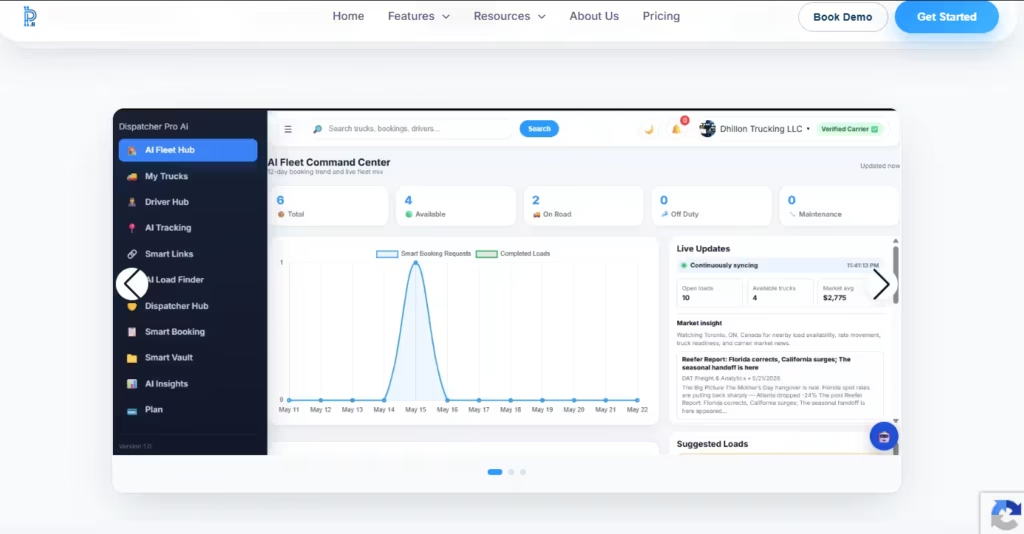
Our vision was to bring those moving parts together into one intelligent workspace where AI supports dispatchers instead of adding another layer of complexity.
That philosophy still guides every feature we build.
We believe technology should reduce operational friction, not create it.
AI should help people make better decisions, not replace the experience they’ve spent years developing.
What the future belongs to businesses that adapt?
Artificial intelligence is changing almost every industry, and logistics is no exception.
What excites me most isn’t the technology itself.
It’s what the technology allows people to accomplish.
Dispatchers can spend more time serving customers.
Fleet managers can make better operational decisions.
Drivers receive clearer communication.
Business owners gain better visibility into their operations.
Everyone benefits when repetitive work is reduced.
That’s the real value of AI.
Not replacing people.
Helping people do their best work.
Why AI matters more than ever?
I don’t think the need for AI comes from technology trends.
It comes from the realities of today’s freight market.
According to the American Trucking Associations, more than 90% of trucking companies operate fewer than 10 trucks. Smaller fleets often have limited staff, which means dispatchers wear multiple hats every day.
The Federal Motor Carrier Safety Administration also reports that there are more than two million registered motor carriers in the United States, creating an increasingly competitive environment where operational efficiency directly impacts profitability.
These numbers reinforce something I’ve observed for years. Small improvements in dispatching create meaningful business results because most trucking companies simply don’t have excess time or resources to waste.
Final thoughts
I’ve spent enough time in logistics to know there isn’t a single piece of software that solves every operational challenge.
Every fleet is different.
And every dispatcher has their own workflow.
and every business has different priorities.
But one thing has become clear.
The companies that embrace intelligent automation today will be better prepared for tomorrow’s transportation industry.
AI dispatch software isn’t about replacing experience.
It’s about making experience more powerful.
If you’re exploring ways to reduce manual work, improve fleet utilization, automate repetitive tasks, and build a more efficient dispatch operation, now is the right time to evaluate how AI can support your business.
At DispatcherPro AI, that’s exactly the future we’re building toward. Our mission is simple. Help dispatchers, carriers, brokers, and fleet owners spend less time managing software and more time moving freight.
Founder Quote:
“I’ve never believed that great dispatching is about working harder. It’s about making better decisions. My goal has always been to build software that gives dispatchers more time to focus on the work only people can do. Build relationships, solve problems, and keep freight moving. Everything else should be handled by intelligent automation.”
Frequently Asked Questions
What is dispatch management software?
Dispatch Management Software is a digital solution that helps businesses assign, schedule, track, and optimize deliveries or service jobs. It improves communication, route planning, resource allocation, and operational efficiency while reducing delays and costs.
Is AI dispatch software only for large trucking companies?
No.
One of the biggest misconceptions is that AI is only useful for enterprise fleets.
In my experience, small dispatch companies, owner-operators, and growing fleets often see the biggest improvements because automation removes administrative work that would otherwise require additional staff.
How is AI dispatch software different from traditional dispatch software?
Traditional dispatch software stores and organizes information.
AI dispatch software goes a step further by analyzing operational data, identifying patterns, recommending actions, and automating repetitive workflows.
Instead of simply showing information, it helps you make better decisions.
Can AI replace human dispatchers?
I don’t believe it can.
Dispatching is built on relationships, communication, negotiation, and experience.
AI handles repetitive operational work, but people will always be responsible for making the final decisions and building customer relationships.
What should I look for when choosing AI dispatch software?
I recommend looking beyond feature lists.
Choose software that is easy to use, integrates with your existing systems, provides real operational insights, supports automation, and can scale alongside your business.
If your team enjoys using the platform every day, you’ve probably made the right choice.